

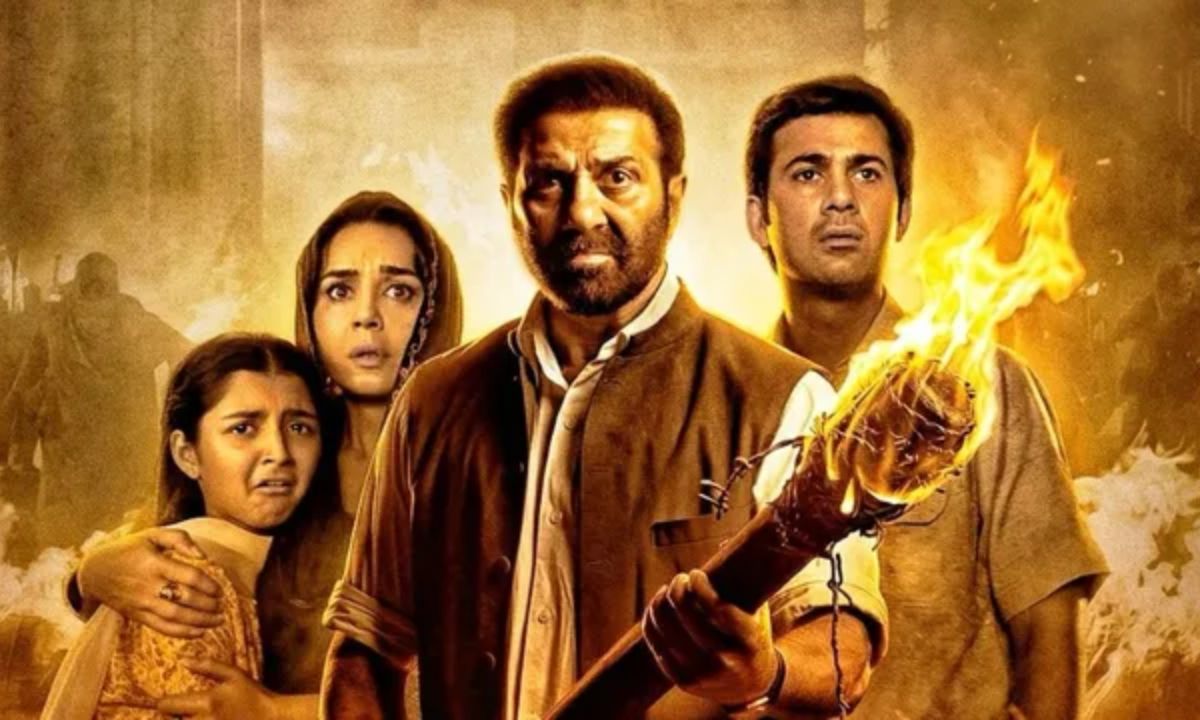
These days there is so much happening across the country that it often feels like humanity has completely disappeared. At moments like these, cinema steps in to plant a small seed of faith and slowly raise hope that goodness still lives inside people and always has. That is exactly what Batwara 1947, directed by Rajkumar Santoshi and starring Shabana Azmi, Sunny Deol, Preity Zinta, Abhimanyu Singh, Karan Deol and Ali Fazal, sets out to do. The film tries to remind audiences that even in the darkest times people can still choose to stay kind. Does it actually deliver that impact? Read on to know all about it.
Plot
Sikandar Mirza lives in Meerut with his wife Hamida and their kids Javed and Tanno. The family is getting ready to celebrate Independence Day. However, riots explode and everything turns chaotic overnight. They have no choice but to pack up and head for Lahore. At the packed railway station the violence gets so intense that young Javed gets pulled away from the group and disappears into the crowd. Once they reach Lahore, Sikandar tries to piece life back together. A quiet poet named Habeeb helps him get a house allotted. The catch is that an elderly Hindu woman everyone calls Mai is already living there. She refuses to leave the house or the city no matter what. But it isn’t easy for Mai. Yakub Pahalwan has his eyes on every empty Hindu house and now wants hers too. He sends threats and tries to scare her into leaving. However, Sikandar and his family refuse to abandon her and promise to protect her no matter the cost.
Performances
Sunny Deol fits the role of Sikandar pretty well. He plays a solid family man who keeps trying to do the right thing even when it costs him. He brings that familiar strong energy that makes the character feel grounded. Preity Zinta comes across as believable as Hamida. She shows a wife who sticks by her husband through every rough patch and quietly holds the family together with steady emotional support.
Shabana Azmi completely owns the role of Mai. She is the definition of resilience and softness and it all feels natural. She becomes the heart of the whole film and it is hard not to root for her. Karan Deol, who plays Javed, feels underwhelming. The struggle with dialogue delivery is noticeable and the performance never quite settles. He still has a long way to go.
Abhimanyu Singh as Yakub does a solid job of making people angry at his actions, yet the character sometimes comes across as more “heroic” than truly intimidating. Ali Fazal appears only for a short while as Habeeb but leaves a strong mark. His calm presence and gentle words make the belief in humanity feel real and possible.
On the technical side the film does not always match its good intentions. The cinematography stays pretty average and the colour grading looks too clean and modern in a lot of places. Not every old-time story needs that ultra-sharp HD finish. A more raw and lived-in look would have matched the 1947 setting better and given the heavy emotions more texture. Some scenes move too fast while others drag, so the overall flow never fully clicks.
Verdict
In today’s world filled with so much hate and anger, Batwara 1947 feels like a film we truly needed. Many people have started losing their faith in humanity. Everywhere we look, there is division, blame, and darkness. This movie steps into that space and offers something different.
Set during the painful days of Partition, it shows people who still chose to respect their faith and remain decent human beings, even when times were extremely rough. Life around them was full of fear, loss, and violence, yet they held on to basic kindness and dignity. Watching the film makes you realise that being a good person is not automatic. Humanity is a choice, and we all need to deliberately make that choice every day, no matter how hard the situation gets.
Also Read: Operation Safed Sagar Review: Siddharth, Dia Mirza Starrer Drama Is Engaging In Most Parts!
I really liked this strong and timely message. It stays with you after the film ends. However, I am not a big fan of the cinematography. I expected better colour grading. Not everything needs to look ultra-HD and polished; sometimes a more natural, textured look would have suited the story better. The dialogues weren’t extraordinary either. I had hoped for good ones that would have made the film sharper and more crisp, but only one or two stood out. A few performances also felt underwhelming and lacked depth. Still, the heart of the film is excellent. For its important reminder about choosing humanity, Batwara 1947 is worth watching.
Also Read: Bhai Tera Star Hai Review: Raghav Juyal’s Film Leaves You With A Headache!